FAQs
What's the best whistle?
Everyone has different tastes, both in how a whistle sounds, and how a whistle handles. Some like airy whistles, with lots of mystique. Others like sweet and pure whistles. Some whistles are exquisitely crafted by master craftsmen. Others look a little rougher and more rustic. Loud, soft, hard blowing, soft blowing. People just have different tastes. The best you can do is try to get a whistle that meets up with your tastes and expectations. And If you're new, those tastes and expectations are going to change as you grow.
That's why I started reviewing whistles, which you can find in the Reviews section. There are other reviewers as well: Phil Hardy, maker of Chieftain whistles, has a reviews section on his Kerry Whistles website. James Peeples reviews whistles and flutes on Flutesite
That's why I started reviewing whistles, which you can find in the Reviews section. There are other reviewers as well: Phil Hardy, maker of Chieftain whistles, has a reviews section on his Kerry Whistles website. James Peeples reviews whistles and flutes on Flutesite
Aren't more expensive whitles better than cheap ones?
Again, that depends on your perspective. For some people, the answer to that is clearly "yes". But for some people, the answer is "no, they're not." It depends on what you want out of a whistle. Think about it in guitar terms. There are always going to be some people who want the new shiny thousand-dollar guitar. And some people who think the $100 pawn-shop special suits them just fine. It's not the price, but whether or not the whistle behaves according to your needs.
But don't all the really good musicians just play Generations?
Nope. This is a bit of a whistle "urban legend". While it's true that many of the old players played Generations, some also played Clarkes. Back then, that was pretty much all they had to choose from! Nowadays, many good musicians from Ireland and around the world play all manner of whistles, from Sindts to Copelands. Even some of the old legends have begun playing high-end instruments. Mary Bergin, for instance, plays Sindts, Generations, O'Riordans and Copelands in her recordings. Finbar Furey played an Indian bamboo flageolet in the key of Ab-ish for his famous Lonesome Boatman tune. Later this bamboo instrument got broken, and that's basically how Bernard Overton got started making low whistles.
The important thing to remember is that good music comes from the whistler, not the whistle. A whistle suited to your style of playing may make playing more fun and enjoyable, but all the 'good stuff' is gonna come from you. That's isn't to say that having a good-sounding instrument won't inspire you to be a better player. It might. But only you can determine what "good sounding" means.
The important thing to remember is that good music comes from the whistler, not the whistle. A whistle suited to your style of playing may make playing more fun and enjoyable, but all the 'good stuff' is gonna come from you. That's isn't to say that having a good-sounding instrument won't inspire you to be a better player. It might. But only you can determine what "good sounding" means.
So, what do the famous whistlers play?
Be aware that I'm not part of the whistle player paparazzi. Any list like this will likely have errors, or be incomplete or out of date (as the pros sometimes change their preferences too!). But I've asked around a few times, and here is my current list:
- Muireann Nic Amhlaoibh: Cillian O'Brian
- Sarah Bauhan: Abell
- Mary Bergin: Generation, Sindt, Copeland, O’Riordan
- Cormac Bretnacht: Susato
- Tim Britton: Copeland
- Mick O Brien: Generation, Burke
- Andrea Corr: Mostly Walton's black whistles. I've seen her playing a Generation Bb while Celine Dion sings "My Heart Will Go On".
- Geraldine Cotter: Sindt, Generation
- Kevin Crawford: Susato
- Mick Crehan: Generation
- Brid Donoghue: Cillian O'Brian, Generation
- Rosin nic Donncha: Susato
- Liam Flynn: Generation, Burke
- Sir James Galway: Abell
- EJ Jones: Abell
- Kathleen Keane: Burke
- Tommy Keane: Generation
- Paddy Keenan: Grinter, Cillian O'Brian, Kerry Pro Low D, Copeland
- Grey Larson: Copelands
- Joanie Madden: O'Riordan, Burke
- Paddy Maloney: Sindt, Generation, Burke
- Cathal McConnell: Generation, Overton
- Mike McGoldrick, Kerry Pro Low D
- Laurence Nugent: Copeland
- Sean Potts: Tweaked Generation, Humphrey
- Brendan Ring: Overton
- Sean Ryan: Susato
- Breda Smyth: Generation
- Sean Smyth: Susato
- Cillian Vallely: Chieftain
- Gavin Whelan: Sindt, Generation
- Shannon Heaton: Burke
If you think someone should be on the list, or I have some information wrong, please let me know! And if you're going to tell me someone plays a different instrument, please back that up with where you saw it, or CD liner notes or something. Thanks!
Surely there are some truly bad whistle brands out there.
Yup, there are. There are whistles that I would never attempt to make music on. But you know, in today's litigious society, I really can't publish a page that says "This brand of whistles is garbage." I'd probably get sued. The best I can do is review whistles and try to give as objective and unbiased a review as I can. But yes, there are some bad brands out there. If I haven't reviewed a whistle you're interested in, feel free to drop me a line, or go to the Chiff and Fipple message board and ask around. I'm sure someone will be able to help you out!
Ok, so what's your favorite whistles?
For playing in public I prefer Abells, Milligans, Oz whistles and Copelands. Roughly in that order, though each is different enough that they all get some play depending on what the venue is like (hot, cold, loud, etc). Each of these are strong players, with rich tone, and very dependable. Fow low whistles, lately I've been playing the MK Pro.
In 2025, I got my hands on a Fred Rose whistle, and it really ticks all my boxes. Loud, clear, easy to play, strong tone. Unfortunately, I don't play in public as much as I used to, so I haven't really had the opportunity to get to know it better. East Texas is an IRTrad cultural wasteland. Someone save me!
In 2025, I got my hands on a Fred Rose whistle, and it really ticks all my boxes. Loud, clear, easy to play, strong tone. Unfortunately, I don't play in public as much as I used to, so I haven't really had the opportunity to get to know it better. East Texas is an IRTrad cultural wasteland. Someone save me!
Celtic or Irish Traditional?
I find myself saying Celtic a lot when describing the music I play. I'm not a strict Irish Traditional player. I play Scottish tunes, Irish tunes, and Breton tunes. I've even played the odd English tune. Heck, whistle is used in a lot of non-Celtic settings as well, such as Kwela music from Africa. But my interest is primarily Euro-Celtic, and so I call the music I pay "Celtic". There are people who turn their nose up at that, and more power to them. If you want to play strictly IR-Trad, feel free to ignore the other parts of my archive. While I have sections for religious songs, kids' tunes and the like, Celtic will remain the sites primary focus unless my interests change.
How do I get started?
There are a number of good tutorials. I started with the Bill Ochs book and cassette tutorial, The Clarke Tinwhistle. If you want something free and on the internet, Brother Steve's Tinwhistle Page is a great place to start. For video resources, Michael Eskin's Tradlessons.com and Sean Cunningham's WhistleTutor both offer close-up videos of whistle playing. Sean in particular has excellent in-depth discussions of technique and style.
And if you're just looking for a finger chart to get you going, I've got you covered!
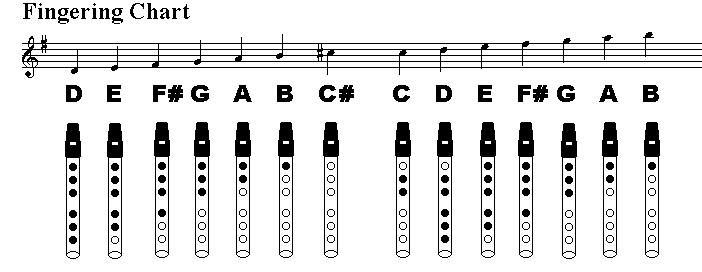
Be aware that the accepted way to hold the whistle is with the right hand on the bottom three notes, and the left hand covering the top three notes. Also be aware that I hold the whistle backwards from that (right hand on top), and a number of top notch players do too, such as Mary Bergin. The only good argument I've ever heard for holding it left-on-top is "so you can play flute later if you want to". They're right. You'll have to play left-handed flutes if you play whistle with your right hand on top. So take that for what it's worth.
You should provide solid pressure on the holes to ensure good coverage, though you shouldn't make your knuckles white! The first three fingers of each hand is used, and the pinkie finger of the right hand provides balance on notes such as C sharp, where all of the holes are open. Practice regularly and you'll find yourself making the notes without any conscious effort.
Second octave notes are made by overblowing (blowing harder into the whistle). The third octave can be reached with special fife fingerings, but this shouldn't be necessary for most traditional Celtic music. Please note the fingering for high D. This can also be fingered with all holes closed, but it can be harder to get a clean sounding high D. I use both fingerings, depending on what tune I'm playing, and which fingering fits the "flow" of the notes.
And if you're just looking for a finger chart to get you going, I've got you covered!
Be aware that the accepted way to hold the whistle is with the right hand on the bottom three notes, and the left hand covering the top three notes. Also be aware that I hold the whistle backwards from that (right hand on top), and a number of top notch players do too, such as Mary Bergin. The only good argument I've ever heard for holding it left-on-top is "so you can play flute later if you want to". They're right. You'll have to play left-handed flutes if you play whistle with your right hand on top. So take that for what it's worth.
You should provide solid pressure on the holes to ensure good coverage, though you shouldn't make your knuckles white! The first three fingers of each hand is used, and the pinkie finger of the right hand provides balance on notes such as C sharp, where all of the holes are open. Practice regularly and you'll find yourself making the notes without any conscious effort.
Second octave notes are made by overblowing (blowing harder into the whistle). The third octave can be reached with special fife fingerings, but this shouldn't be necessary for most traditional Celtic music. Please note the fingering for high D. This can also be fingered with all holes closed, but it can be harder to get a clean sounding high D. I use both fingerings, depending on what tune I'm playing, and which fingering fits the "flow" of the notes.
Sheet music or ear learning?
There's always been some controversy around this question. But since you're on my site, you get my opinion.
The short answer: it's fine to use sheet music to learn the skeleton of a tune. But then put it away as soon as you can, and use your ears to learn the nuance, the rhythm, the flow, and how your local session actually plays it.
There are those people who say that you should never look at sheet music. That somehow by the very act of seeing dots on a page, you are corrupted somehow, and good music will forever be lost to you. This to me sounds superstitious and just a wee bit silly. People make a point that in Ireland many students are required to "learn by ear"...but then upon digging deeper, you'll find that many teachers give "cheat sheets" to students with the notes listed out, writing out whole tunes like this: DED DEG A (the first notes of Blarney Pilgrim). That's sheet music! Anyone who says otherwise is in denial. Whether it's dots or letters, if you write out the entire tune's notes, that's sheet music. Just because one is dots doesn't make it somehow magically cursed.
Like Jazz and many other forms of music, the dots for Celtic music is just a barebones structure, and it often doesn't reflect syncopation, inflection, speed, mood, variation, etc. The sheet music is only there to help jog your memory for the base notes. You should put it away as soon as possible, once you have the notes internalized, and rely on your ear to pick up the musical "language".
Unquestionably, you have to learn to use your ears to pick up Celtic music and do it justice. But honestly, that's true if you want to be good at any genre of music. You will never learn to play music properly playing straight from the page. The sheet music doesn't tell the whole story by a long shot. For instance, hornpipes are usually expressed as quarter note/quarter note/quarter note/quarter note, but played closer to dotted-quarter/eighth/dotted-quarter/eighth. You will definitely need to develop a discerning ear and steep yourself in the music to really learn to play it well. You don't have to be able to hear a tune once and immediately play it back. I've been playing since 1995, and I've only been able to do this a couple of times. There are musicians who can do it easily, of course, but it's not a requirement. You just have to learn to listen to the music in a much more discerning way than a non-musician does, so that you can hear the subtle variations, nuances, etc.
So, I say you can use both: Use your ear to learn the musical language and structure of Celtic music, and you can use sheet music as a tool to help you along with the notes.
The short answer: it's fine to use sheet music to learn the skeleton of a tune. But then put it away as soon as you can, and use your ears to learn the nuance, the rhythm, the flow, and how your local session actually plays it.
There are those people who say that you should never look at sheet music. That somehow by the very act of seeing dots on a page, you are corrupted somehow, and good music will forever be lost to you. This to me sounds superstitious and just a wee bit silly. People make a point that in Ireland many students are required to "learn by ear"...but then upon digging deeper, you'll find that many teachers give "cheat sheets" to students with the notes listed out, writing out whole tunes like this: DED DEG A (the first notes of Blarney Pilgrim). That's sheet music! Anyone who says otherwise is in denial. Whether it's dots or letters, if you write out the entire tune's notes, that's sheet music. Just because one is dots doesn't make it somehow magically cursed.
Like Jazz and many other forms of music, the dots for Celtic music is just a barebones structure, and it often doesn't reflect syncopation, inflection, speed, mood, variation, etc. The sheet music is only there to help jog your memory for the base notes. You should put it away as soon as possible, once you have the notes internalized, and rely on your ear to pick up the musical "language".
Unquestionably, you have to learn to use your ears to pick up Celtic music and do it justice. But honestly, that's true if you want to be good at any genre of music. You will never learn to play music properly playing straight from the page. The sheet music doesn't tell the whole story by a long shot. For instance, hornpipes are usually expressed as quarter note/quarter note/quarter note/quarter note, but played closer to dotted-quarter/eighth/dotted-quarter/eighth. You will definitely need to develop a discerning ear and steep yourself in the music to really learn to play it well. You don't have to be able to hear a tune once and immediately play it back. I've been playing since 1995, and I've only been able to do this a couple of times. There are musicians who can do it easily, of course, but it's not a requirement. You just have to learn to listen to the music in a much more discerning way than a non-musician does, so that you can hear the subtle variations, nuances, etc.
So, I say you can use both: Use your ear to learn the musical language and structure of Celtic music, and you can use sheet music as a tool to help you along with the notes.
How often should I practice?
You should probably practice at least a little bit every day..5-10 minutes. This will help you stay familiar with the tunes you're learning, and help you get comfortable and familiar with the whistle.
At first, practice is going to be really frustrating, because you're having to learn lots of things at once. In addition to the tunes, you're having to learn to coordinate your fingers, breath pressure, rhythm, and when and where to breathe. But trust me, it gets easier with time. Eventually you'll have the "mechanics" down, and you can focus completely on improving your music.
When I first started whistling, I was working from home, so I sometimes practiced for up to 6 hours a day for the first couple of years. I had a Clarke original, with the wood block fipple, and the wood grain would suck the moisture out of my lip, and then my skin would rip off when I pulled the whistle away from my mouth. That's probably a bit extreme.
At first, practice is going to be really frustrating, because you're having to learn lots of things at once. In addition to the tunes, you're having to learn to coordinate your fingers, breath pressure, rhythm, and when and where to breathe. But trust me, it gets easier with time. Eventually you'll have the "mechanics" down, and you can focus completely on improving your music.
When I first started whistling, I was working from home, so I sometimes practiced for up to 6 hours a day for the first couple of years. I had a Clarke original, with the wood block fipple, and the wood grain would suck the moisture out of my lip, and then my skin would rip off when I pulled the whistle away from my mouth. That's probably a bit extreme.
How long does it take to "get good" at the whistle
Well, that depends on what your definition of "Get good" is.
It took me 3 years before I felt comfortable with the whistle. It took me another 3 years or so before I started feeling comfortable making some of the more complex ornaments like rolls and cranns. I'm just now starting to get comfortable learning tunes on the fly, and learning better variations for tunes. I may be really happy with my playing in another 5-10 years.
Your mileage may vary.
I wrote the above answer probably around 2007. Now, in 2018, I can say that I'm fairly happy with my playing. I'm still no virtuoso like Joanne Madden or Kevin Crawford. I've seen videos of teenagers in Ireland playing with such gifted talent that it makes me weep, and I know that I'll probably never be able to play like that. But I think I do OK for myself, and am pretty comfortable with where I'm at.
It took me 3 years before I felt comfortable with the whistle. It took me another 3 years or so before I started feeling comfortable making some of the more complex ornaments like rolls and cranns. I'm just now starting to get comfortable learning tunes on the fly, and learning better variations for tunes. I may be really happy with my playing in another 5-10 years.
Your mileage may vary.
I wrote the above answer probably around 2007. Now, in 2018, I can say that I'm fairly happy with my playing. I'm still no virtuoso like Joanne Madden or Kevin Crawford. I've seen videos of teenagers in Ireland playing with such gifted talent that it makes me weep, and I know that I'll probably never be able to play like that. But I think I do OK for myself, and am pretty comfortable with where I'm at.
What is ABC notation?
ABC notation is a textual representation of sheet music. It's really it's own musical notation language--a text-based way of passing along music notation on Usenet and message boards . It's pretty handy, and there are software packages that can translate from ABC to sheet music.
It looks like this (ABC courtesy of Henrik Norbek's site, which can be found in my links section):
X:3
T:Banish Misfortune
R:jig
D:Tommy Keane & Jacqueline McCarthy: The Wind among the Reeds
D:Chieftains Live.
Z:First bar also played |^fed cAG|
Z:id:hn-jig-3
M:6/8
K:Dmix
=fed cAG|Agd cAG|~F3 DED|~F3 GFG|~A3 cAG|AGA cde|fed cAG|Ad^c d2e:|
|:f2d d^cd|f2a agf|e2c cBc|ece gfe|f2g agf|e2f gfe|fed cAG|Ad^c d2e:|
|:f2g e2f|ded cdc|~A3 GAG|~F3 ded|c3 cAG|AGA cde|fed cAG|Ad^c d2e:|
You can learn more about ABC, and how to learn it, from the The official ABC notation home page. Be aware that since ABC is just another way of writing sheet music, it'll probalby help a lot if you already undestand some of the fundamental concepts of reading sheet music.
It looks like this (ABC courtesy of Henrik Norbek's site, which can be found in my links section):
X:3
T:Banish Misfortune
R:jig
D:Tommy Keane & Jacqueline McCarthy: The Wind among the Reeds
D:Chieftains Live.
Z:First bar also played |^fed cAG|
Z:id:hn-jig-3
M:6/8
K:Dmix
=fed cAG|Agd cAG|~F3 DED|~F3 GFG|~A3 cAG|AGA cde|fed cAG|Ad^c d2e:|
|:f2d d^cd|f2a agf|e2c cBc|ece gfe|f2g agf|e2f gfe|fed cAG|Ad^c d2e:|
|:f2g e2f|ded cdc|~A3 GAG|~F3 ded|c3 cAG|AGA cde|fed cAG|Ad^c d2e:|
You can learn more about ABC, and how to learn it, from the The official ABC notation home page. Be aware that since ABC is just another way of writing sheet music, it'll probalby help a lot if you already undestand some of the fundamental concepts of reading sheet music.
Do you get paid to review whistles?
Absolutely not. The minute you take money for a review, then you risk focusing on pleasing the guy who's paying you rather than informing the public. I have never taken a single dollar for reviewing a whistle, and never will.
Don't you get free whistles to review?
Sometimes. Sometimes, I buy them myself (new or second-hand). And sometimes, I get loaners from whistlers or makers. The O'Riordan whistles I reviewed were loaned to me by an amazingly trusting and kind-hearted whistler. There is just no way to easily get your hands on one of those these days.
Occasionally, I will write to a whistle maker if they are new, or their whistles are particularly hard to get ahold of, and ask if they would like me to review their whistle. Sometimes, whistle makers will write to me, especially if they are new or not very well known.
My policy is as follows: If a whistle is provided by the manufacturer, I generally ask to keep the whistle as a 'product sample'. I don't have a ton of cash to spend on review whistles every year, so I almost always turn around and sell these sample whistles so that I can use the money to buy another whistle to review. I used to make between $600 and $800 a year in ad revenue, and I used that exclusively to pay for hosting and to buy review whistles. But ad revenue has dropped so low that it was better to just drop ads from the site altogether than continue to bother with the tax headaches.
Even though I am receiving a whistle as a product sample, I make it clear to the maker that I am going to give an unbiased review. They aren't 'buying' a good review by giving me a whistle. On more than one occasion, I've received a sample whistle that had problems, and I have mentioned those in my review. On all of my reviews, I try to list whether I purchased the whistle, received it on loan, or if it was a product sample.
If I purchase a whistle second-hand and it has problems, I always contact the maker. Since a prior owner may have caused the issues, I'll ask if they'd like to swap it for a new one more representative of their work. Either way, I always mention any problems in the review, along with how the maker responded.
In rare cases, I will take a product sample from the manufacturer on loan. For instance, my review of the snakewood Thin Weasel was a loaner whistle from Glenn Schultz. But this is not my normal operating procedure. Taking a whistle on loan means that I have to pay to ship it back, and I also have the risk of being responsible for the whistle if somehow I damage it while it's in my care. But in rare circumstances, I will review a loaner whistle from the manufacturer if the maker really can't afford to give away even a single whistle for some reason. This is especially true if it's a popular enough whistle that I feel that there's a bona fide need to have a review in my archive. I'm less likely to agree to a loan arrangement from a newer maker that is hoping to use my review to help launch their whistle making career.
Occasionally, I will write to a whistle maker if they are new, or their whistles are particularly hard to get ahold of, and ask if they would like me to review their whistle. Sometimes, whistle makers will write to me, especially if they are new or not very well known.
My policy is as follows: If a whistle is provided by the manufacturer, I generally ask to keep the whistle as a 'product sample'. I don't have a ton of cash to spend on review whistles every year, so I almost always turn around and sell these sample whistles so that I can use the money to buy another whistle to review. I used to make between $600 and $800 a year in ad revenue, and I used that exclusively to pay for hosting and to buy review whistles. But ad revenue has dropped so low that it was better to just drop ads from the site altogether than continue to bother with the tax headaches.
Even though I am receiving a whistle as a product sample, I make it clear to the maker that I am going to give an unbiased review. They aren't 'buying' a good review by giving me a whistle. On more than one occasion, I've received a sample whistle that had problems, and I have mentioned those in my review. On all of my reviews, I try to list whether I purchased the whistle, received it on loan, or if it was a product sample.
If I purchase a whistle second-hand and it has problems, I always contact the maker. Since a prior owner may have caused the issues, I'll ask if they'd like to swap it for a new one more representative of their work. Either way, I always mention any problems in the review, along with how the maker responded.
In rare cases, I will take a product sample from the manufacturer on loan. For instance, my review of the snakewood Thin Weasel was a loaner whistle from Glenn Schultz. But this is not my normal operating procedure. Taking a whistle on loan means that I have to pay to ship it back, and I also have the risk of being responsible for the whistle if somehow I damage it while it's in my care. But in rare circumstances, I will review a loaner whistle from the manufacturer if the maker really can't afford to give away even a single whistle for some reason. This is especially true if it's a popular enough whistle that I feel that there's a bona fide need to have a review in my archive. I'm less likely to agree to a loan arrangement from a newer maker that is hoping to use my review to help launch their whistle making career.
Hey, your sheet music for that tune isn't the way I play it!
Well, I'm not surprised.
Folk music is a living, oral tradition. That means that as the music is transmitted from musician to musician, it tends to change over time. I've played in a lot of different sessions, in Houston, Dallas, northern Virginia, Maryland, Pennsylvania, and even got to play a bit in Ireland on my honeymoon. And every session I've been to has had different variations on the tunes.
The tunes in my archives only represent one possible way that the tune might be played. It's not definitive. If your session plays a tune differently, then you'll need to use your ears to make up the differences. Or ask someone for sheet music to the version they play at your session. But if you already know most of the tune as they play it, picking out the differences isn't that difficult, and good practice for learning by ear.
The tunes in my archive were compiled from various sources, and where my local session played a tune differently, I've done my best to reconcile the differences by ear.
Folk music is a living, oral tradition. That means that as the music is transmitted from musician to musician, it tends to change over time. I've played in a lot of different sessions, in Houston, Dallas, northern Virginia, Maryland, Pennsylvania, and even got to play a bit in Ireland on my honeymoon. And every session I've been to has had different variations on the tunes.
The tunes in my archives only represent one possible way that the tune might be played. It's not definitive. If your session plays a tune differently, then you'll need to use your ears to make up the differences. Or ask someone for sheet music to the version they play at your session. But if you already know most of the tune as they play it, picking out the differences isn't that difficult, and good practice for learning by ear.
The tunes in my archive were compiled from various sources, and where my local session played a tune differently, I've done my best to reconcile the differences by ear.