Overton Soprano D whistle Review
(Review written June 2005)
- Preface
-
It's next to impossible to talk about the history of low whistles without talking about Bernard Overton. In the 60's and 70's, Finbar Furey was quite a popular folk musician, and known for his tune The Lonesome Boatman, which he played on a low-whistle-like Indian flageolet pitched in Ab and made of bamboo. When Finbar's instrument was sat on and destroyed at a party, Bernard stepped up to the plate, offering to copy it in metal. The rest, as they say, is history. Around 1993, Colin Goldie and Phil Hardy partnered up to make Overton whistles under license from Bernard Overton, but that arrangement didn't last. Phil Hardy went on to make the Chieftain/Kerry line of whistles, while Colin continues to make Overton whistles under license. Bernard Overton has also come out of semi-retirement to make whistles again. Read
the Colin Goldie interview on the Chiff and Fipple website for more interesting tidbits of information.
Update: Colin Goldie now makes whistles under his own brand and website at Colin Goldie Whistles - At a Glance
- Whistle Reviewed
- Overton Soprano D whistle
- Models Available
- Tunable and non-tunable whistles from Soprano F to Bass G
- How Acquired
- received secondhand
- Construction
- Aluminum body with aluminum fipple
- Price at Time of Review (in US Dollars unless otherwise noted)
- EURO € 125 (about $152 USD) for non-tunable D
- Available From
-
Overton Whistles
Big Whistle
The Whistle Shop
Song of the Sea
Sheehans and many more
- Appearance
- Like most high-enders, Overton whistles have their own distinctive look. Once you learn their features, they're pretty easy to recognize. The mouthpiece area is squared off and is narrower than the rest of the whistle, which is basically an aluminum pipe. This Overton has a brushed finish that has a silky feel to it, but the Overton website FAQ does have instructions on how to polish it to a chrome-like shine, if that's your preference. Some people seem to confuse Chieftain and Overton whistles, and superficially they are similar, but once you are aware of the differences between them, there really should be no confusion.
-

Here's the full whistle. In a picture this size, it's really hard to see the features that make the Overton unique. But hey, that's what close-ups are for!
Here's a close-up of the mouthpiece. The labium ramp is short and steep. The whistle reminds me of the Alba SE I reviewed a while back. I think they look a lot alike, probably due to their similar squared-head shape. But there are some important differences. The Alba is squared all the way around (which you can see in the review), but the Overton is really only squared on the top and two sides. The bottom retains it's rounded shape. Unlike the SE, Colin has given the mouthpiece the same kind of brushed finish as the rest of the whistle, helping lend a uniformity to it's look. The Overton has more a precise-looking construction, and the labium appears to have been ground into the whistle, where the Alba SE's blade appears to have been constructed by pressing, rather than grinding.
Here's another angle on the mouthpiece, showing the fipple area. The fipple is aluminum, and the windway is small and squared. This design didn't have nearly as many problems with clogging as I was afraid it might with the small windway (though to be fair, nearly all completely aluminum whistles are a bit cloggy).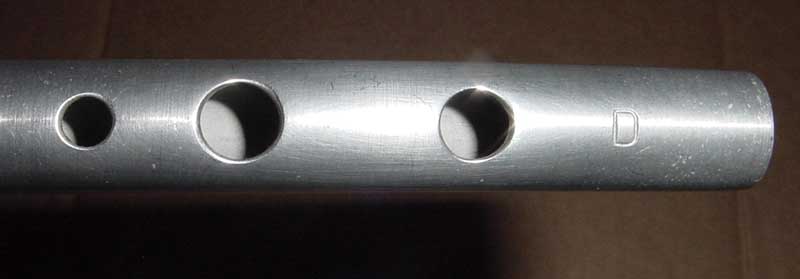
A shot at the end of the whistle, showing the last three holes. The key of the whistle (in this case, "D") is stamped here below the last hole.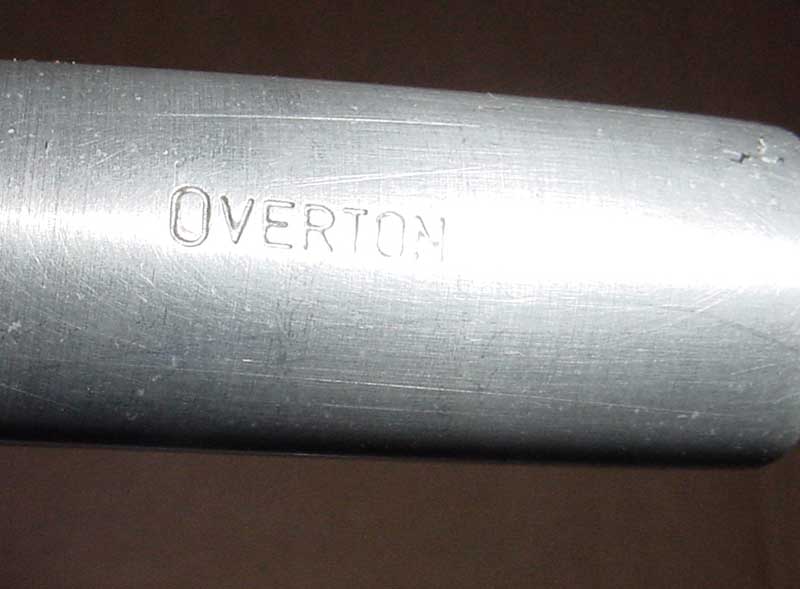
On the backside of the whistle near the foot is the Overton stamp. You may see this stamped as "CSG Overton" on older whistles made by Colin, but since 1999 or so he has just stamped them "Overton"
Colin signs inside the bodies of the whistles he makes. This one reads "Colin Goldie Oct 2002".
- Playing Characteristics
- It's important to note here that I exchanged a couple of long emails with Colin Goldie. I often do this before I publish a review, to clear up any questions and to dig for more information that I may not readily have available. Colin pointed out to me that there is a lot of variance possible in the Overton design. He often makes whistles to specific volume, breath, and hole size/placement requirements. The whistles he sells to stores are usually a mix of easy-blowing and hard-blowing instruments. Colin says that once an instrument is made, there is not really much revoicing that's possible to change it's playing style. The point being: You should try before you buy. Failing that, you should contact the Overton folks directly so that they can make a whistle to your exact requirements. With each whistle sold to an individual possibly being a custom job, and with stores getting a variety of types of whistle, that means there's a lot of variation out in marketplace, you're just taking the gamble that you'll wind up getting an instrument you don't like if you "buy blind" online. As an example, while I was writing this review, someone sent me a sound clip of an Overton to listen to that they were evaluating for purchase. It was an easy-blowing instrument and was definitely weaker in the 2nd octave than the one I have, which he didn't like. I sent him a short clip of this Overton (which is a little harder blowing), and he liked the second octave better. I suggested if he really wanted an Overton, he should contact Colin and get a custom one made. This is basically the same advice Colin gave: If you can't try before you buy, call them and let them make one to your specifications.
-
Sound clips of the whistle:
Gravel WalkTone: Very slightly reedy, with a complex chiff. Also, the sound wasn't as harsh as some loud aluminum soprano whistles. It's definitely a bit sweeter, though the tone is still quite strong.
Volume: Above average, but with a wide variance (though this does change the pitch), and increasing dramatically in the 2nd octave, especially in the top end. By way of comparison, when played in tune, the first octave was slightly louder than my Meg, and the second octave was quite a bit louder than the Meg's. In some ways, this reminds me of a Susato.
Responsiveness: Plenty responsive. No issues playing ornaments at a fast clip.
Tuning: When blown with the proper breath control, this instrument is in tune when warmed up. This particular whistle is a non-tunable, and like all non-tunables, care should be take to make sure it's warmed to be fully in tune.
C-natural: OXXOOO produces a sharp C-Natural. Of course, this means that OXOOOO is very sharp. OXXXOX is just right.
Hole size and placement: The holes are well-rounded, polished and slightly chamfered. The E hole is a little larger than usual. D hole is placed a little away from the pack. Neither of these things caused me any issues. There's also a little bit of a gap between the first three and the last three holes. Since most people cover the first three holes with fingers from one hand, and the last three with fingers from another, this should in no way be an issue. I've heard of at least one player that plays with four fingers from one hand and two from the other, though...if you're one of these types, the hole spacing may take a little getting used to. But I would expect that only a couple of people on the planet play that way.
Air volume requirements: slightly lower than average. This was expected, due to the very small windway.
Air pressure requirements: Medium, with a medium amount of backpressure. This requirement goes up to high in the 2nd octave, and if you're a little shy or treat this instrument gently up there, it will reward you by falling out of the octave and honking at you. You have to keep the pressure on and your breath precise with this whistle. I found that if I played my Meg after playing this whistle, I tended to overblow the Meg, until I readjusted to the Meg's pressure requirements. Neither of the D's are particularly easy to control. The first octave D is a little weak, and takes a less breath than the notes above it. You also have to be careful hitting the second octave D quite precisely if you're using XXXXXX. If your breath control is off, this whistle has a tendency to honk that note.
Clogging: When played cold, started clogging right away. The Overton website is up front about this whistle really needing to be warmed up before playing to help with moisture control. When warmed, didn't start to clog until 25 minutes or so, so pretty average. The whistle didn't cut out when wet, but the second octave did become pretty unruly, becoming harder to hit without honking. Like most aluminum whistles, if air conditioning vents onto it directly, it does a good job of going cold and then getting cloggy. I would recommend giving this whistle the Duponol treatment.
Wind Resistance: Poor. I usually initially judge wind resistance by seeing how the whistle handles the 1-tune 30-foot walk from the parking lot when I stop by the supermarket after work, and while pumping gas at any random gas station that I happen to be at when I have the whistle with me. I figure these are good ways to get a non-contrived setting for wind testing. A breeze cut this one out on me during the parking lot walk before I had gotten 3 notes out. I was hoping that with the added backpressure, this might have made a good outdoor whistle but it was not to be.
- Summary
- This whistle reminds me a little bit of a wild stallion. It's a little tough to handle at first, but once you get it under control, it's quite nice. I'll need more time with this whistle before I really feel comfortable with it, I think. Due to the tricky breath control required, the volume, and the breath pressure ramping up as you go up the scale, I imagine that beginners would struggle with this instrument.